
Tuesday, July 15, 2014


Doing an AMA on Reddit now
Hi reddit. My name is William Baird. I am the CEO and founder of Team Phoenicia. We are an orbital payload manifesting company. We started out as a Google Lunar XPRIZE entrant and now we are specialists in commercial space launch management, making sure someone will make it to the moon. We have already manifested Pennsylvania State University's Lunar Lion team and are working on manifesting another two GLXP teams. We will also be providing launch slots for low earth orbit commercial satellites and the very small cubisats.
The Phoenicia-1 mission (our next launch: http://i.imgur.com/yZpWylw.jpg (F9 fairing used for planning purposes only)) is currently planned for Dec 2015. We will be aggregating a large number of payloads; upwards of 20 satellites plus around 60U of cubesats. Some of the cubesats will be the first ever past low earth orbit. Each U of a cubesat is 10cm x 10cm x 10cm. Cubesats come in 1U, 3U, 6U , 12U and 27U flavours. We have partnered with Adamworks, Spaceflight, Applied Defense, Space Exploration Engineering, Tyvak, Astrotek, USN and others, in order to deliver a strong and viable mission.
Among the payloads we are manifesting is the Lunar Iditarod - a micro rover challenge where teams build, qualify and then race rovers the size of a smart phone. The winning three rovers will be carried to the moon on one of the GLXP landers, where they will race again on the lunar surface. They will carry cameras that will allow us to follow the races at home. The finalists may be university students, engineering startups, your mechanically-inclined next door neighbor, and even you!
I grew up in Los Alamos, NM (and I glow in the dark). I attended New Mexico State University. I have worked for Los Alamos National Lab, Northrop Grumman, White Sands Missile Range's High Energy Laser Systems Test Facility and Lawrence Berkeley National Lab. In my career I have developed control systems as a defense contractor, used and operated some of the fastest computers in the world, shot down missiles and rockets with lasers for the US military, designed and programmed robots for industrial and space exploration purposes, helped astronomers on some of the earliest exoplanets, and am now working with rockets and payloads.
Or as I like to put it..... I have worked on death rays, proto terminators, skynet and spaceships. All I need now is a tropical volcanic island. No, I am not bald and I don't put my fingers to the corner of my mouth. And I DEFINITELY don't wear a cape.
link.
Thursday, May 15, 2014
Announcing the RevUp Render Lunar Iditarod: a Micro Rover Robotics Challenge

Dogecoin is Going to the Moon!
Team Phoenicia and RevUp Render Launch the Ultimate Dogecoin
Competition—the Lunar Iditarod Micro Moon Rover Competition
MENLO PARK, CA—May 15, 2014—“To the Moon!”—a familiar slogan that
resonates in the Dogecoin community—is on its way to becoming a real-life
event. Team Phoenicia, Inc. and RevUp Render, Inc. have joined forces to roll
out the next big Dogecoin challenge—the RevUp Render Lunar Iditarod
Competition. Fueled by Dogecoin digital currency, which is similar to Bitcoin,
participants will compete in a three-way race on the moon, racing mini moon rovers
(DogeSleds) the size of smart phones. Details about the event can be found on
the Iditarod competition website at lunariditarod.revuprender.com.
The RevUp Render Lunar Iditarod will unfold in several stages over the
next year and a half. The first stages of the competition will narrow the field
of competitors to three Dogecoin-themed DogeSled moon rovers. For the final
stage of the competition, the three chosen DogeSleds will be placed aboard a
lunar lander and physically carried to the moon on Team Phoenicia’s Phoenicia-1
mission scheduled for Q4 2015. The final stage of the competition involves the
actual race, which will take place on the moon after the three DogeSleds have
disembarked from the lunar lander.
The Dogecoin-themed event is the culmination of space meets the cloud—Team
Phoenicia’s discovery of an unmet need in the private space industry and RevUp
Render’s custom cloud technology for design and engineering, which allows teams to collaborate on complex design
projects from any location. Team Phoenicia, which is manifesting the
Phoenicia-1 mission, will deliver payloads to low-earth orbit and the moon. In
November 2013, Pennsylvania State University’s Google Lunar X PRIZE team, the
Lunar Lions, was the first payload to reserve a slot on the Phoenicia-1 launch
in 2015.
“Team Phoenicia was a Google Lunar X PRIZE (GLXP) team for several years
before withdrawing to focus on the launch,” said William Baird, CEO, Team
Phoenicia. “We realized the launch itself was as challenging as the rest of the
prize. If someone did not focus exclusively on the launch, no team was likely
to make it to the moon.”
“The Iditarod
is the perfect way for the Dogecoin community to push the limits of digital
currency and advanced engineering to achieve something that has never been done
before—racing micro-rovers on the moon,” explains Ry Bruscoe, president of
RevUp Render. “Participants will have access to our advanced cloud computing
technologies to push their designs to new heights. We can’t wait to see what
the Lunar Iditarod teams create in the most ambitious challenge to date for the
Dogecoin community.”
“Team Phoenicia is proud to support the RevUp Render Iditarod Challenge.
We bring our experiences in past challenges, the contacts made through those
experiences, and of course, the launch itself,” explained Baird. “The Dogecoin
community is well positioned for growth beyond being just another
cryptocurrency. By cross pollinating the Dogecoin, robotics, and NewSpace
communities, we create an opportunity for these vastly different communities to
learn from one another, creating something that is stronger and better than we
ever imagined. Not only are we offering to help the Dogecoin community achieve its
goal of ‘To the Moon,’ we are helping to create a market for Dogecoin that will
help increase demand for the cryptocurrency around the world.”
Within a period of five months, Dogecoiners funded the Jamaican Olympic
bobsled team, sponsored a NASCAR driver, and rallied behind numerous charities.
Unlike these previous sponsorships, The RevUp Render Lunar Iditarod, is not
reliant on crowdfunding. At its core, this event is about extending Dogecoin
awareness and usage by incorporating Dogecoin marketing and transactions into
the competition requirements. The Lunar Iditarod is the ultimate vehicle for
getting Dogecoin “To the Moon!”
Competition
Brief
· RevUp
Render Lunar Iditarod Competition website: lunariditarod.revuprender.com.
· The RevUp
Render Lunar Iditarod is a multi-stage, multi-year lunar mini rover
competition.
· The first
four stages of the competition will be held in the San Francisco Bay Area featuring
a lunar regolith simulation.
· The final
stage will include three micro moon rovers physically racing on the surface of
the moon.
· The
judging panel will include professionals in the space industry and Dogecoin
community.
About
Team Phoenicia
Team Phoenicia is an orbital payload broker and service provider.
Founded in 2007, Team Phoenicia entered the spacecraft payload manifesting
market in 2010 with the purpose of making space access more routine for small
spacecraft. Team Phoenicia is headquartered in Menlo Park, California.
About
RevUP Render
RevUp Render, Inc. offers cloud computing for architectural
visualization, video game design, motion graphics, vifual effects, and more.
The company's goal is to bridge the gap between the creative mind and model
rendering through advanced collaborative design & review technology. Visit www.revuprender.com.
All products or brand names mentioned are
trademarks or registered trademarks of their respective holders.
Tuesday, December 10, 2013
Team Phoenicia Announces Agreement with Space Exploration Engineering for Space Traffic Control Services
Menlo Park, CA. – Dec 9, 2013 – Team Phoenicia LLC, a space payload services provider, announced today an agreement with Space Exploration Engineering Corporation of Friday Harbor, WA to provide “space traffic control” for the multiple spacecraft to be launched on the 2015 Phoenicia-1 launch.
The Phoenicia-1 launch will be one of the most complex missions ever attempted. With multiple spacecraft simultaneously heading to the Moon - led by PennState's Lunar Lion Google Lunar XPRIZE team's lander - each of these spacecraft will require simultaneous tracking and maneuver planning, which requires shared ground tracking resources and cooperative collision avoidance. This requires a system similar to Air Traffic Control used for commercial aviation. Space Exploration Engineering (SEE) will provide “space traffic control” for the Phoenicia-1 launch.
“The Phoenicia-1 Mission will be ground-breaking. With Penn State’s Lunar Lion Google Lunar XPRIZE team and more, Phoenicia-1 will set the stage for commercial missions beyond Earth orbit, the Moon, and potentially interplanetary space,” said Baird. “SEE’s capabilities will help ensure mission success.”
Team Phoenicia will provide launch opportunities to Pennsylvania State University’s Lunar Lion Google Lunar X PRIZE team, California Polytechnical University at San Luis Obispo, Tyvak Nanosatellite Systems and Spaceflight Services, Inc. on the Phoenicia-1 (P-1) mission using a commercial domestic launch vehicle. The launch will carry over twenty small satellite payloads and potentially up to 75 cubesat payloads. Many of these payloads will be released in a sun-synchronous, polar Earth orbit, and several additional payloads will continue to the Moon.
SEE will design, create and manage a Space Traffic Control center for this mission using a commercial ground station, through which all trajectory planning, deployments, orbit determination and maneuvers will be planned and coordinated. This capability will then be available for subsequent missions in Earth orbit and beyond.
SEE is a partnership of aerospace professionals with expertise in mission design, operations and spaceflight dynamics. SEE has decades of experience in spaceflight operations from sun-synch, rendezvous, re-entry, lunar, libration-point and deep space trajectories.
"With so many years of experience, there are few comparable in the commercial market to what SEE brings to the table for this mission. Mike Loucks and his associates are some of the best in the business." stated William Baird, CEO of Team Phoenicia. "As our alliance for space exploration and development grows, SEE brings to the table the experience from IBEX, LADEE and other missions to help plan and execute this mission. The new capabilities SEE is bringing online for the Phoenicia-1 mission will enable missions for years to come. We are thrilled to be the first to use this new capability."
“The Phoenicia-1 mission is a very exciting opportunity for us.” said Loucks, President of SEE. “Our previous experiences with flight dynamics and control on IBEX and LADEE have put us in a unique position to fly commercial deep space and lunar missions. The experience we gain on this mission will dovetail nicely into our future goals as well, and position us to be leaders in commercial deep space. Our Space Traffic Control system will be based on commercial software, and will enable cubesats and other secondary payloads to fly with the same type of precision that we used to put LADEE in lunar orbit.”
Team Phoenicia is an orbital payload broker and service provider. Founded in 2007, Team Phoenicia entered the spacecraft payload manifesting market in 2010 with the purpose of making space access more routine for small spacecraft. Team Phoenicia is headquartered in Menlo Park, California.
The Phoenicia -1 launch will be scheduled for the 4th quarter of 2015.
Wednesday, November 27, 2013
coy
Don't think PennState is the only thing in the oven. More very, very soon.
And an explanation as to why we withdrew from the GLXP.
And an explanation as to why we withdrew from the GLXP.
Monday, November 25, 2013


The Roar of the Lion Changes all
November 25, 2013
Roaring to the Moon, Lunar Lion Pays Launch Reservation Fee
UNIVERSITY PARK, Pa. -- The Lunar Lion, a Moon lander designed and built by the Penn State Lunar Lion team, the only university-led team in the Google Lunar XPRIZE competition, will be sent into space as part of a multiple spacecraft effort coordinated by a new player in the space industry, Team Phoenicia LLC, of Menlo Park, Calif.
The Lunar Lion team's fully refundable launch reservation fee has been paid to Phoenicia.
"Phoenicia has brought together a complementary set of payloads, filling a need in the industry," said Michael Paul, director of space systems initiatives at Penn State's Applied Research Lab.
Paul, who leads Penn State's team of researchers and students on the Lunar Lion mission, pointed out that this is a significant milestone for the project.
"This gives us the advantage of clear program planning and clear fundraising goals," he said. "It also means that the clock is ticking toward those goals."
Funding for the Lunar Lion mission, 90 percent of which must be derived from private sources according to competition rules, is coming through a mix of individual gifts and corporate support while leveraging existing assets at Penn State.
Phoenicia President William Baird said he spent many years seeking a launch opportunity as a secondary payload for his own team's entry into the Google Lunar XPRIZE. He realized secondary payloads were overly restricted and that today's payloads need more flexible options.
Those options were not yet available, so Phoenicia changed course, exiting the Google Lunar XPRIZE competition and choosing to fill this niche in the growing array of space launch services.
"The fundamental problem with launching to space is the cost of entry for new companies in the aerospace field," said Baird. "A small launch vehicle costs as much as $10 million, and larger ones range from $60 to $120 million. Both these prices leave out additional processing costs which, when pulled together, represent a significant barrier to entry. Another model was and is needed. We believe, through aggregating payloads, we have found that model."
Under terms of an agreement between the parties, Phoenicia will contract with a launch vehicle provider and provide systems integration services for a launch to be shared by several spacecraft, the largest of which being the Lunar Lion.
Additionally, Phoenicia is using a SHERPA, built by Spaceflight Inc., to accommodate additional secondary payloads to maximize the launch vehicle's full capacity. SHERPA, developed by Spaceflight's sister company, Andrews Space, accommodates payloads up to 660 pounds on each of five available ports, includes a propulsion system and links other subsystems to operate as both a hosted payload platform and an in-space maneuvering stage. Spaceflight will immediately make available ports on SHERPA to bring additional spacecraft to low earth orbit and a trans-lunar injection orbit.
"The cost saved by committing to this launch is considerable," said Paul. "We initially used the listed cost of an entire launch vehicle in our fundraising targets and mission budget projections. Now we only have to target a fraction of that cost for launch and can apply our energy and funding to other areas of the mission."
Penn State is taking advantage of this unique opportunity to achieve a lunar trajectory without having to bear the full cost of the launch vehicle.
"While the Lunar Lion is the largest spacecraft on this launch, it will be accompanied by several mid-sized Earth satellites that will be placed in low Earth orbit," said Baird. "Once those customers' spacecraft have been released, the Lunar Lion will be pushed on to its lunar-intercept trajectory, accompanied by other payloads, including several CubeSats."
Those CubeSats, each about 2 pounds and 4 inches on a side, are built jointly by Tyvak Nano-Satellite Systems LLC and California Polytechnic State University - San Luis Obispo. The Tyvak-Cal-Poly CubeSats will be deployed from the launch vehicle using the Phoenicia Lunar Payload Delivery Rack.
The Google Lunar XPRIZE will be awarded to the first privately funded team to land a spacecraft on the Moon, move it 500 meters, and send back video, images and data before the end of 2015. No spacecraft has landed on the Moon since the Soviet Union's Luna 24 landed Aug. 22, 1976. To date, only spacecraft built by the Soviet Union and the United States have landed on the Moon, 19 in total between 1966 and 1976. The winner of the Google Lunar XPRIZE will be the first privately funded spacecraft to land on the Moon.
Contact:
Andrea Elyse Messer (814) 865-9481 aem1@psu.edu
About Penn State Lunar Lion
The Penn State Lunar Lion team is the only university-led team competing for the Google Lunar XPRIZE, with the goal of executing the first privately-funded mission to the surface of the Moon while creating a new generation of leaders for a new era in space exploration. More than 80 students, guided by Penn State faculty and staff, as well as professionals from a host of companies, is responsible for the design, construction, testing, and operation of the Lunar Lion, which will land on the Moon, take off and land more than 500 meters from its original landing site, and send video, images, and data back to Earth. For the future, for the glory, for all … the time is now! Visit us on the web at www.lunarlion.psu.edu and follow @lunarlionpsu
About Team Phoenicia LLC
Team Phoenicia is an orbital payload manifesting company. Team Phoenicia's first payload, Phoenicia-1, will be flying in 4Q2015. Team Phoenicia was founded in 2007 as to compete in the Google Lunar XPRIZE and evolved into the manifesting market when attempts at finding a ride as a secondary payload were unsuccessful for its competition bid. Team Phoenicia is headquartered in Menlo Park, California.
About Spaceflight
Spaceflight Inc. -
The Space Logistics Company- provides frequent, cost effective, and routine access to space for deployed and hosted payloads. Spaceflight specializes in the launch of CubeSats, nanosatellites and microsatellites with mass between 1 kg and 300 kg. Through its global network of launch vehicle providers, Spaceflight can deploy payloads to low Earth orbit, the Moon, and beyond. Visit us on the web at www.spaceflightservices.com and follow @spaceflightinc
Friday, June 7, 2013
Wednesday, May 29, 2013
Tuesday, November 13, 2012
3rd Nanosat Launcher Seminar has been canceled
Team Phoenicia regrets to announce that the Nanosat Launcher Seminar has been canceled.
This is due to multiple reasons. The first is that there has been low interest this time around. Additionally, a number of speakers have cancelled as of today and Space Florida is unable to attend in person.
Those that have registered will be getting refunds.
Tuesday, September 18, 2012
3rd Annual Team Phoenicia Nanosat Launcher Seminar: Registration Now Open

Registration is now open. The current draft agenda is here and evolving.
Early registration will be $50 (9/19/2012 through 10/1/2012)
Full Registration will be $75 (10/1/2012 through 10/31/2012)
Late Registration will be $100 (11/1/2012 through 11/16/2012)
Walkin Registration is $125 (11/17/2012).
All reservations will be confirmed!
Email with questions
Monday, September 17, 2012
3rd Team Phoenicia Nanosat Launcher Seminar: Draft Agenda

Here is the delayed draft of the 2012 Nanosat Launcher Seminar agenda. There will be some changes over time. We are awaiting some speakers confirmation prior to officially putting them on the agenda. Registration will open on Wednesday.
Early registration will be $50 (9/19/2012 through 10/1/2012)
Full Registration will be $75 (10/1/2012 through 10/31/2012)
Late Registration will be $100 (11/1/2012 through 11/16/2012)
Walkin Registration is $125 (11/17/2012).
AGENDA:
Nov 17th:
8 AM to 8:50 AM: Sign in and continental breakfast
8:50 AM to 9:00 AM: Welcome by William Baird of Team Phoenicia
9:00 AM to 11:00 AM: Draft Rules Input for the Community, Space Florida, Percy Luney
11:15 AM to 11:30 AM: BREAK
11:30 AM to 12:30 PM: FAA AST Presentation
12:30 PM to 1:30 PM: Lunch, Lunch Speaker
1:30 PM to 2:30 PM: PPOD User Requirements, Cal Poly SLO/Tyvak, Roland Coelho
2:30 PM to 2:45 PM: BREAK
2:45 PM to 3:45 PM: Cubesats and Nanosat Launchers, Pumpkin, Inc, Dr Andrew Kalman
3:45 PM to 4:00 PM: BREAK
4:00 PM to 5:00 PM: Funding Panel, Wade Woodson, TBD
5:00 PM to 6:00 PM: Speakers (potentially test sites) TBD
6:00 PM to 7:00 PM: Dinner, with speaker
7:00 PM to 8:00 PM: Feedback to Rules for the Nanosat Launcher Challenge, Percy Luney
8:00 PM to 10:00 PM: TBD
8:00 PM to 10:00 PM: TBD
Wednesday, September 12, 2012
Announcing the Third Annual Team Phoenicia Nanosat Launcher Challenge Seminar
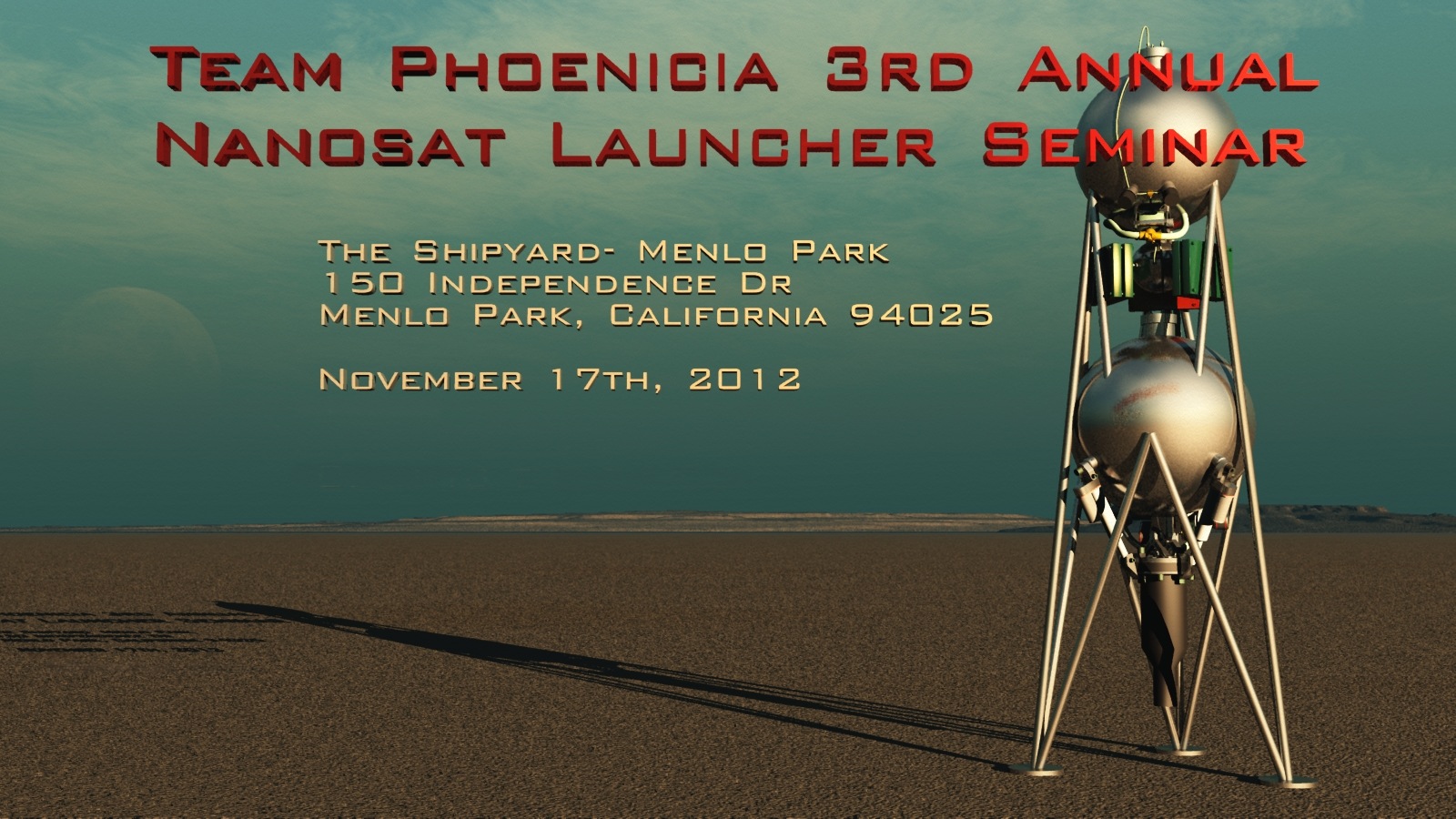
Team Phoenicia is proud to be hosting the Third Annual Nanosat Launcher seminar at its facility in Menlo Park, CA on November 17th, 2012. This seminar will be one day only this year and will cover the rules with participation by Space Florida, requirements for flight as covered by the FAA AST, requirements for use of the PPODs by Cal Poly/Tyvak, uses and needs from the nanosat community by Dr Andrew Kalman of Pumpkin Inc and more.
A draft agenda will be posted by Friday 9/15/12.
Registration to begin on Monday 9/18/12.
Monday, July 30, 2012
The Cal Poly, Team Phoenicia and Tyvak, oh my! Q&A over the press release
Blatantly stolen from here. We're working on updated one because we loved it.
We've
had a number of questions over the past week. They've run a gamut of
topics, but they, by and large, boil down to one thing. What does that
press release mean? Can you use nonPR english? We grinned and thought,
"sure!"
1. What does the it mean to collaborate like it says?
1a.
It means that every time that Team Phoenicia launches its landers
towards the moon, Cal Poly and Tyvak will be buying excess mass and
volume for deploying lunar and interplanetary cubesats.
2. Interplanetary cubesats? Excuse me?
2a. This is best covered by a video presented by NASA JPL's Robert Staelhe based on a study down under the aspises of NIAC:
Likewise, Gizmag covered one of the concepts that NASA is studying and Dr Staehle covers above.
3. Isn't a bit early to be talking interplanetary cubesats? They have some time to mature as yet.
3a. They do, but in one case they've already flown an important bit of hardware.
The cost of cubesat based space probes is so much less that if they
build a little, test a little, fly a little, and even fail a little, the
entire development cost will be far, far less than even a discovery
mission.
4. Who is Adaptive Launch Solutions?
4a. Here.
5. Will your Phoenicia Lunar Payload Rack System (Legion System), work only with the ALS A Deck ESPA rings?
5a. No. We can mate it to any ESPA ring of the proper diameter.
6. So you are divvying up the secondary payload on a launch, right? How much will that cost?
6a. Yes. That's under NDA, sorry, but contact us and we will happily forward one to you if we're interested in doing business.
7. Who should we contact about the nanosat slots?
7a. Tyvak and Cal Poly. Its their volume and space.
8. What is this about the contract being a long term relationship?
8a.
Team Phoenicia is pursuing the Google Lunar X PRIZE. Our first launch
will be pursuant of that goal. We will NOT be stopping with the GLXP.
We want to launch as often as we can and place payloads on the moon.
Every time we go, Tyvak and Cal Poly will go. This opens up
interplanetary space to cubesat derived probes, etc.
9. Will Cal Poly and Tyvak be willing to work with other teams?
9a.
No. And yes. Cal Poly and Tyvak are exclusively with Team Phoenicia
for launching payloads for the Google Lunar X PRIZE. They will not be
working with other teams to place cubesats on their flights. However,
if there is a piece of $tech that is for sale on their website or
whatnot, they are more than welcome to sell it. If there is a question
regarding a grey area, the parties will consult.
10.
Are there other slots available for a small sat in the Legion System
with Phoenicia's lander and the cubesat PPODs in place?
10a.
Yes, there is. The cylindrical volume you see below in the video
deploying is an unnamed or open slot. We have groups negotiating for
the slot. We hope to announce the first group that has signed on in the
near future. However, this is a long term coalition, not just a one
off. We are going to have slots available over the next decade that are
not always going to be filled. Contact us to discuss costs and
requirements.
11. Are you willing to work with other teams?
11a. We will leave it at 'yes.'
12. When is the first launch planned?
12a. We're aiming for 2014. More soon.
13. Can you tell us home much money is coming from this?
13a. Its seven plus figures per launch. Its very favourable to all parties.
14. Can you tell us more?
14a. Soon.
Thursday, July 26, 2012
Wednesday, July 25, 2012
Team Phoenicia Unveils Coalition For Lunar and Interplanetary Launches
Team Phoenicia, Tyvak Nano-satellite Systems LLC and California Polytechnic State University - San Luis Obispo Team for the Google Lunar X PRIZE and Interplanetary Launch Opportunities
Menlo Park, CA, (July 25, 2012) Team Phoenicia announced today they have teamed up with Tyvak Nano-Satellite Systems LLC and Cal Poly, San Luis Obispo (Cal Poly) to work on lunar and interplanetary small satellite and CubeSat launch opportunities. This teaming arrangement covers collaboration on the $30 million Google Lunar X PRIZE; collaboration on future interplanetary and lunar nanosat Launches; and tapping into each other's knowledge bases for both the competition flights and beyond.
The Google Lunar X PRIZE, the largest incentivized competition offered to date, challenges space professionals and engineers from across the globe to build and launch to the moon a privately funded spacecraft capable of completing a series of exploration and transmission tasks. The Google Lunar X PRIZE is one of three active competitions from the X PRIZE Foundation, the leading nonprofit organization for creating and managing large-scale, global incentivized competitions.
The single biggest hurdle for any team in the Google Lunar X PRIZE is getting to the Moon. Any launch for any single team is a difficult financial hurdle. Team Phoenicia originally approached Cal Poly and Tyvak about the prospect of collaborating on the Google Lunar X PRIZE. The discussion was based on the premise that Team Phoenicia would have excess launch capacity on their lunar missions and Cal Poly/Tyvak would utilize this excess capacity for NanoSat and CubeSat interplanetary or lunar missions. This would offset the total cost of any launch that Team Phoenicia would contract for, even ones beyond the X PRIZE competition.
From this starting point and given the exciting state of development for interplanetary CubeSats, Team Phoenicia, and Cal Poly, and Tyvak forged a deeper relationship. Cal Poly and Tyvak will integrate its CubeSat launchers - Poly Picosatellite Orbital Deployers (P-POD) in 1U, 3U, and larger NanoSat form factors - with the Phoenicia Lunar Payload Delivery Rack (aka the Legion System) designed for use on the internal structure of the EELV Secondary Payload Adaptor (ESPA ring). A version of which is optimized for use on the Adaptive Launch Solutions Aquila System.
All Team Phoenicia flights will offer P-POD slots to the small satellite community through Cal Poly and Tyvak. This exciting element enables NanoSats/CubeSats to be deployed outside of low earth orbit and into interplanetary space. The first studies of "interplanetary NanoSats" are being conducted by several NASA research centers, the Jet Propulsion Lab, and several universities.
Interplanetary NanoSats are envisioned as CubeSat sized space probes that ply the space between the planets. These would utilize upgraded CubeSat technologies and projected to cost between $5 million to $10 million. Proposed missions include asteroid rendezvous, comet inspections and even sample returns from the Martian moons of Phobos and Deimos.
By teaming on launches and technology development, Cal Poly, Tyvak, and Team Phoenicia will be offering the first launch opportunities dedicated to interplanetary NanoSats.
In the 1990s, NASA instituted the Discovery Program. This produced a renaissance in planetary science by successfully conducting over ten missions in fifteen years rather than one or two flagship missions like before. With interplanetary NanoSats coming to fruition, NASA could have hundreds of missions out plying the asteroids, comets and orbiting the Moon, Mars and other bodies simultaneously for the same time frame. With this far lower cost, universities could potentially fly their own probes as part of a normal planetary science research program.
"Team Phoenicia is beyond excited about the prospect of flying the first interplanetary NanoSats. Not only will we be conducting the first soft landing on the Moon since 1976, we will be helping to spark a revolution in space probes. We are deeply honored by Cal Poly and Tyvak teaming with us on this great endeavor."
"This partnership with Team Phoenicia brings an incredibly unique opportunity to the CubeSat community. Only a few months ago, the first interplanetary CubeSat workshop was held at MIT. At the workshop representatives from academia, industry and government met to discuss new and exciting interplanetary missions that can be implemented using CubeSats. Together we hope to utilize this excess launch capacity to bring these missions to reality," said Coelho.
"Team Phoenicia has always felt that the Google Lunar X PRIZE is not just about getting to the Moon, but fostering the NewSpace business ecology. Here with Tyvak and Cal Poly, we have developed another ecological link, a very productive one that will allow academia, NASA and others in the nanosat industry to tie into NewSpace technological diversity," said Baird.
"The CubeSat community has always pushed the boundaries of technology development and has worked hard to provide access to space to new players in the space business. This partnership is a great example of this New Space movement and we're excited to be a part of it with Team Phoenicia," said Puig-Suari.
"Team Phoenicia is very excited to be working with both Cal Poly and Tyvak. With their help, we are making significant progress on the goals of the Google Lunar X PRIZE, both getting to the Moon and developing the Final Frontier," Baird said.
Media Contacts:
William Baird
Team Leader
Team Phoenicia
510 331 5869
wbaird@teamphoenicia.org
Thursday, April 19, 2012
Nanosat Launcher Challenge Draft Rules Posted

Space Florida has posted the draft rules (pdf) for the Nanosat Launcher Challenge. The intent is for the public to comment on them. Please do.
Tuesday, March 20, 2012
Team JURBAN Selects Team Phoenicia Engines for GLXP Lander

Menlo Park, CA:
March 20, 2012
Team Phoenicia announced today they were selected to provide the rocket engines to power Team JURBAN’s competition lunar lander for its landing on the surface of the Moon. Both teams are competing for the $30 million Google Lunar X PRIZE, the largest incentivized competition offered to date, challenging space professionals and engineers from across the globe to build and launch to the moon a privately funded spacecraft capable of completing a series of exploration and transmission tasks.
Both teams expressed mutual interest in collaborating after they met in the Google Lunar X PRIZE Team Summit last summer where they participated and discussed the rules of the competition as well as presented their progress and status of their bids to land onthe Moon. The first area of collaboration is the outfitting of JURBAN’s lander withTeam Phoenicia’s engines.
Team JURBAN’s lander will incorporate two Z150a rocket engines that will be fired to decelerate and land on the Moon. This is a crucial step inwinning the Google Lunar X PRIZE. “The safe landing of the rover for theGoogle Lunar X PRIZE is crucial and difficult. JURBAN’s selection of TeamPhoenicia’s engines both honors and delights us. We are going to the Moon! Not just once! Not just through our own efforts! But with another team as well!” stated Team Phoenicia's Team Leader, William Baird. "Having a rocket engine in hand has already created additional investors and sponsor interest, and has energized our team members who are anxiously waiting to see some fire,” stated Blaze Saunders. “With JURBAN being a computer science and electrical engineer strong team, the mutual data and hardware exchange partnership with Team Phoenicia will allow both teams to move much faster."
To date, there is only one minority group in the personal space flight industry that merits attention – the JURBAN team, directed by Dr. Jayfus T. Doswell and technically and artistically managed by Blaze Sanders and Morgan Glaze respectively. JURBAN or the *Juxtopia® Urban RoboticsBrilliant Application Network* team plans to win the $20 million X PRIZE Grand Prize by using our new shiny engines in a single 526 second burn to slow down the JURBAN airbag landing system from 3,580 mph to a gentle 60mph impact: a simple and low cost / sustainable system that will open up the Moon and Mars to scientists around the world.
“Team Phoenicia has always felt that the Google Lunar X PRIZE is not just about getting to the Moon, but fostering the NewSpace business ecology. Our partnership with Team JURBAN is another outstanding example of the links in that ecology growing under the auspices of the Google Lunar X PRIZE,” said Team Leader William Baird. The Z150a Rocket engine is primarily a RP-1/LOX engine with 150 lbs-f thrust. The Z150a differs from the previous Z150 engines with the addition of an integral ignitor. The Z150, Z150a and Z550 along with as yet unrevealed engines are designed and built by Team Phoenicia at its Menlo Park facility. The Z-series engines can be used with other hydrocarbon fuels besides RP-1 and have been.
The JURBAN Team is from Baltimore, Maryland and comprised of African American high school and college students from Historically Black Colleges and Universities (HBCU) and Minority Serving Institutions (MSI) as well as professional engineers in management positions.
Team Phoenicia is a Google Lunar X PRIZE participant and is looking to land its rover on the Moon in 2014. Team Phoenicia has been pursuing the Google Lunar X PRIZE since November 2007 and is based in Menlo Park, CA.
ABOUT THE GOOGLE LUNAR X PRIZE
Generously funded by Google, the $30 million Google Lunar X PRIZE is an unprecedented competition to challenge and inspire engineers and entrepreneurs from around the world to develop low-cost methods of robotic space exploration. To win the Google Lunar X PRIZE, a privately-funded team must successfully place a robot on the Moon’s surface that explores at least 500 meters (1/3 of a mile) and transmits high definition video and images back to Earth. The first team to do so will claim a $20 million Grand Prize, while the second team will earn a $5 million Prize. Teams are also eligible to win a $1 million award for stimulating diversity in the field of space exploration and as much as $4 million in bonus prizes for accomplishing additional technical tasks such as moving ten times as far, surviving the frigid lunar night, or visiting the site of a previous lunar mission. To date, more than 20 teams from a dozen countries around the world have registered to compete for the prize. The Google Lunar X PRIZE is available to be claimed until the end of the year 2015. For more information, visit www.googlelunarxprize.org.
ABOUT X PRIZE FOUNDATION
Founded in 1995, the X PRIZE Foundation, a 501(c)(3) nonprofit, is the leading organization solving the world’s Grand Challenges by creating and managing large-scale, high-profile, incentivized prize competitions that stimulate investment in research and development worth far more than the prize itself. The organization motivates and inspires brilliant innovators from all disciplines to leverage their intellectual and financial capital for the benefit of humanity. The X PRIZE Foundation conducts competitions in four Prize Groups: Education & Global Development; Energy & Environment; Life Sciences; and Exploration. Prizes won include the $10 million Ansari X PRIZE for private, suborbital space flight; the $10 million Progressive Insurance Automotive X PRIZE for creating safe, affordable, production-capable vehicles that exceed 100 MPGe (energy equivalent); the $2 million Northrop Grumman Lunar Lander X CHALLENGE for advanced rocket development; and the $1.4 million Wendy Schmidt Oil Cleanup X CHALLENGE for highly effective, ocean
surface oil spill cleanup methods. Active prizes include the $30 million Google Lunar X PRIZE, the $10 million Archon Genomics X PRIZE presented by Medco, and the $10 million Qualcomm Tricorder X PRIZE. For more information, go to www.xprize.org.
ABOUT GOOGLE, INC.
Google's innovative search technologies connect millions of people around the world with information every day. Founded in 1998 by Stanford Ph.D. students Larry Page and SergeyBrin, Google today is a top web property in all major global markets. Google's targeted advertising program provides businesses of all sizes with measurable results, while enhancing the overall web experience for users. Google is headquartered in Silicon Valley with offices throughout the Americas, Europe and Asia. For more information, visit www.google.com.

Monday, March 19, 2012
Subscribe to:
Posts (Atom)


 Posts
Posts

